
Marker technique
How to avoid streaks with alcohol markers
Seeing stripes or darker patches on your coloring page? Start with one small area: three simple habits can help you lay down color more evenly. You do not need to redo the whole page or tackle a large background.

Quick answer
Three habits to try: color one small area at a time, overlap each stroke slightly, and keep going while the ink is still wet. Begin with a petal or a mug rather than a large background.
Keep your pressure light and steady, and place a protection sheet behind the page. If an area has already dried, avoid repeatedly going over just the streak: it can create a darker patch.
Start with a single petal
A flower petal gives you a small area to begin with. Lay down a light color with close, overlapping strokes, working towards the edge without leaving gaps. Move on to the next petal afterwards rather than trying to fill the entire flower at once.
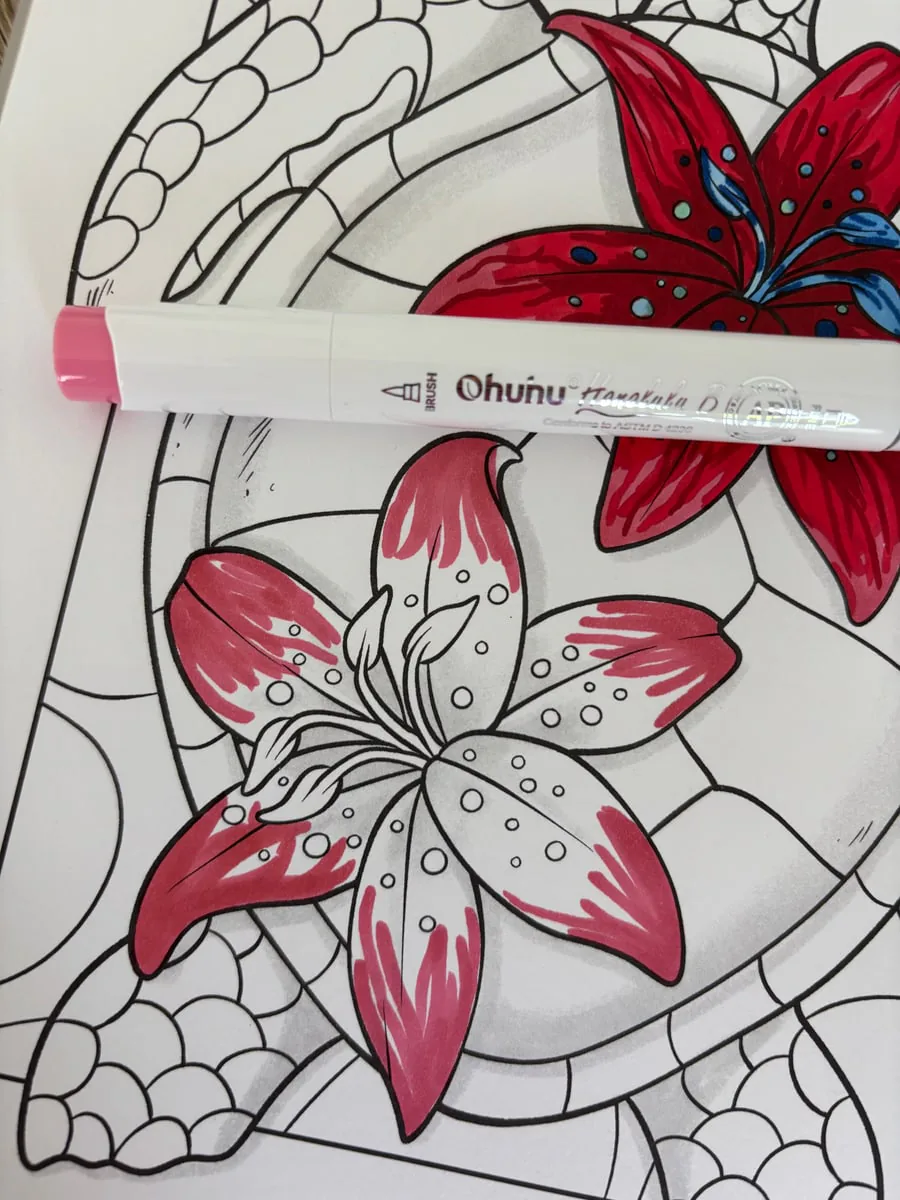
This photo comes from the four-step flower coloring tutorial. It shows the first pink layer, before shadows and details. You can follow these steps with colors you already own.
Why streaks appear
Alcohol marker ink looks smoother when it has time to settle evenly. If one part of the area is already dry when you go back over it, the new stroke can leave a visible edge. Rough or very absorbent paper makes this happen faster.
Pressure also matters. If you press harder in one part and lighter in another, the page receives different amounts of ink.
The simple beginner routine
- Choose a small area first, like a mug, cushion, leaf or flower.
- Use one direction for your strokes.
- Overlap each stroke a little before the edge dries.
- Add a second layer only if the first layer looks too light.
- Save dark colors for small shadows, not full backgrounds.
Choose colors that are close together
Blending is easier when the colors are close: dusty pink with pale pink, caramel with cream, sage green with light green, warm grey with beige. Big jumps between colors are harder to smooth out.
For cozy coloring, the blend does not need to be perfect. A clean transition is enough to make the page look finished.
Paper changes the result
Very absorbent paper dries the ink quickly and gives you less time to smooth the area. Smooth paper is usually easier for practice. In a coloring book, place a protection sheet behind your page every time.
If paper is your main issue, read the guide on best paper for alcohol markers before buying more markers.
Can you fix streaks after they happen?
If the streaks are light, a clean second layer across the whole area can sometimes even them out. If the streaks are strong, stop before the paper gets too wet. You can turn the mark into a shadow, texture, pattern or small detail instead.
On cozy pages, small imperfections can become wood grain, fabric, fur, wall texture, shadows or leaf texture.
Common causes and simple fixes
| Problem | Likely cause | Simple fix |
|---|---|---|
| Visible bands | Strokes are too far apart | Overlap each stroke slightly. |
| Dark patches | Too many layers in one spot | Pause before adding more ink. |
| Hard edges | The first area dried before you went back | Work in smaller sections. |
| Bleed-through | Paper is too absorbent or too wet | Use a protection sheet behind the page. |
Key takeaways
- Small areas are easier than large backgrounds.
- Steady strokes and light pressure reduce streaks.
- Paper affects streaks as much as marker choice.
- Close colors blend more cleanly than high-contrast colors.
FAQ
Why do alcohol markers leave streaks?
Streaks often happen when the ink dries unevenly, the paper absorbs too fast, or the pressure changes across the area.
How do you color smoothly with alcohol markers?
Work in small areas, keep your strokes steady, overlap each stroke slightly and go back only while the ink is still fresh.
Does paper affect alcohol marker streaks?
Yes. Smooth, less absorbent paper usually gives you more time to fill an area before streaks appear.
Can I fix alcohol marker streaks?
Light streaks can sometimes be reduced with an even second layer. Heavy streaks are often better hidden with shadows, texture or small details.
Are water-based markers more streaky?
They can be more streaky if you want a very smooth finish. They are still useful for simple coloring and practice.